

Hinchco Memorial Shoot
In memory of Jim Hinchco
Jim assisted the Massey Archery Club with sponsorship and advice but just as important was the inspiration he provided through his status as "The Master" in getting the club started. Unsurprisingly he was asked to open the club at its site in Red Hills Road with Jim shooting the first arrow, made by his son in law, Jerry Jessen. Jim was awarded the first honorary membership at the club for his support and inspiration.
James William Hinchco
Born 1910 in Huntly, James Hinchco, affectionately known as Jim to all who knew him, was one of the greatest archers New Zealand has ever produced, with a career that spanned over 30 years in the sport. He was a master bow maker, engineer and inventor, and his devotion and hard work shaped the development of archery in New Zealand from soon after the war years until his death in 1978.
Jim did not start out an archer. He was an engineer and sheet metal worker at a business he started, making a variety of items including hot water cylinders. He had married Mabel in 1934, and they lived in Mangere in Auckland. When the war began, Jim joined the Air Force, becoming a Sergeant Instructor, and was part of the 30th Service Unit, appended to the 30th (Dive Bomber) Squadron. Being a part of the service unit, it was his job to help maintain the aeroplanes, and they were sent to Gisborne for training before being deployed to the Pacific.
In 1943, the Gisborne Rifle Club (due to lack of ammunition) had become the Gisborne Archery Club. Jim was in need of entertainment while in training, and had seen the archers at the club once or twice. He attended their "have a go" night, and met the renowned Jim Burton, who was to become one of New Zealand's greatest target archers. Burton gave the new recruit many free tips, and Jim Hinchco became fascinated with the sport.
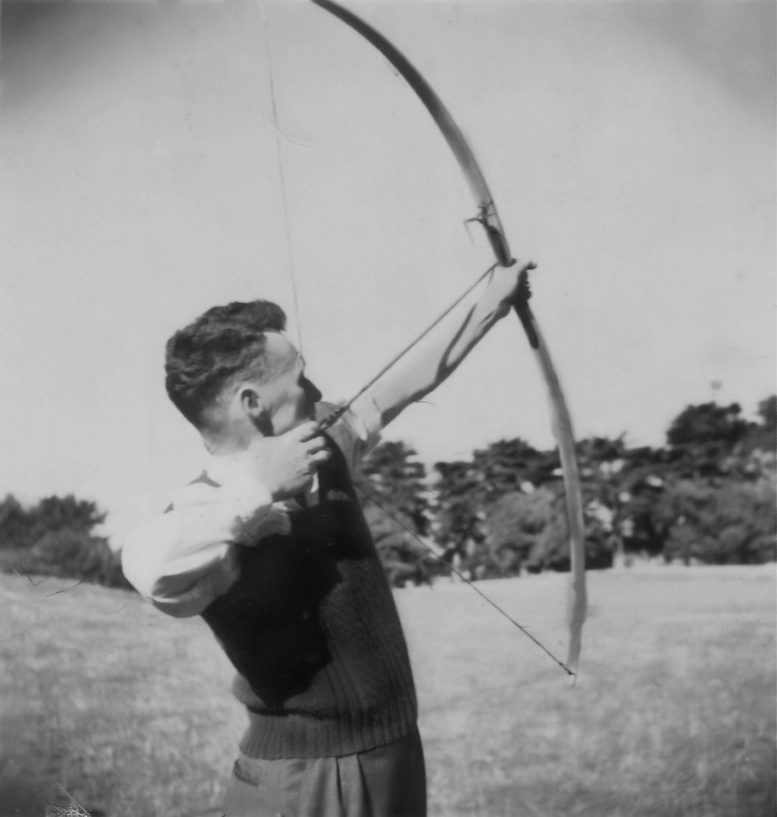
He did not have much time to indulge his new-found interest, as the RNZAF sent his unit into the war in the Pacific, where Jim was stationed in Green Island, Guadalcanal and Bougainville Island. It was not until 1946, when he returned to Auckland, that Jim was able to think about archery again. He instantly joined the very recently-founded Auckland Archery Club in One Tree Hill, and bought a new bow.
Within six months, the bow had broken. After trying to get it fixed, he decided to buy a new one. However, when the second one broke, and he was unable to fix it, he realised it was more worth his money and while to make his own, and followed the example of Hugh Butel in Dunedin. Archery tackle was practically unobtainable in New Zealand due to import restrictions, and it wasn't long before Jim was a full-time bowyer, supplying those in Auckland with his craft. During this time there was little indication of what was to come. Jim was keen with a bow, yet his results were hardly anything startling.
Practice produces results, and when Jim entered the National Championships in 1949, which were held in Carlaw Park, Auckland, he gained fifth place overall. This was a mark of things to come, for in December, Jim made a clean sweep of the Auckland Club Championships, also winning their Clout and Columbia shields. He held the Columbia Shield for another five years in a row. In 1950 his results further improved, climbing to 3rd in the Target and 2nd in the Olympic round in the National Championships.
At around this time, the New Zealand Archery Association (now Archery NZ) created an award they named the "Master Bowman" award. The criteria was notoriously difficult. Created partially because it was an incentive for archers to make their own equipment, archers had to win all of the NZ merit pins, and a Field Championship title, all with equipment of their own making. Jim Hinchco was the only person in New Zealand who came close to qualifying for this award – yet he was denied receiving it in 1951 due to the fact that the Council wanted to defer awarding it until "we have three Archers in New Zealand who can fulfil the conditions".
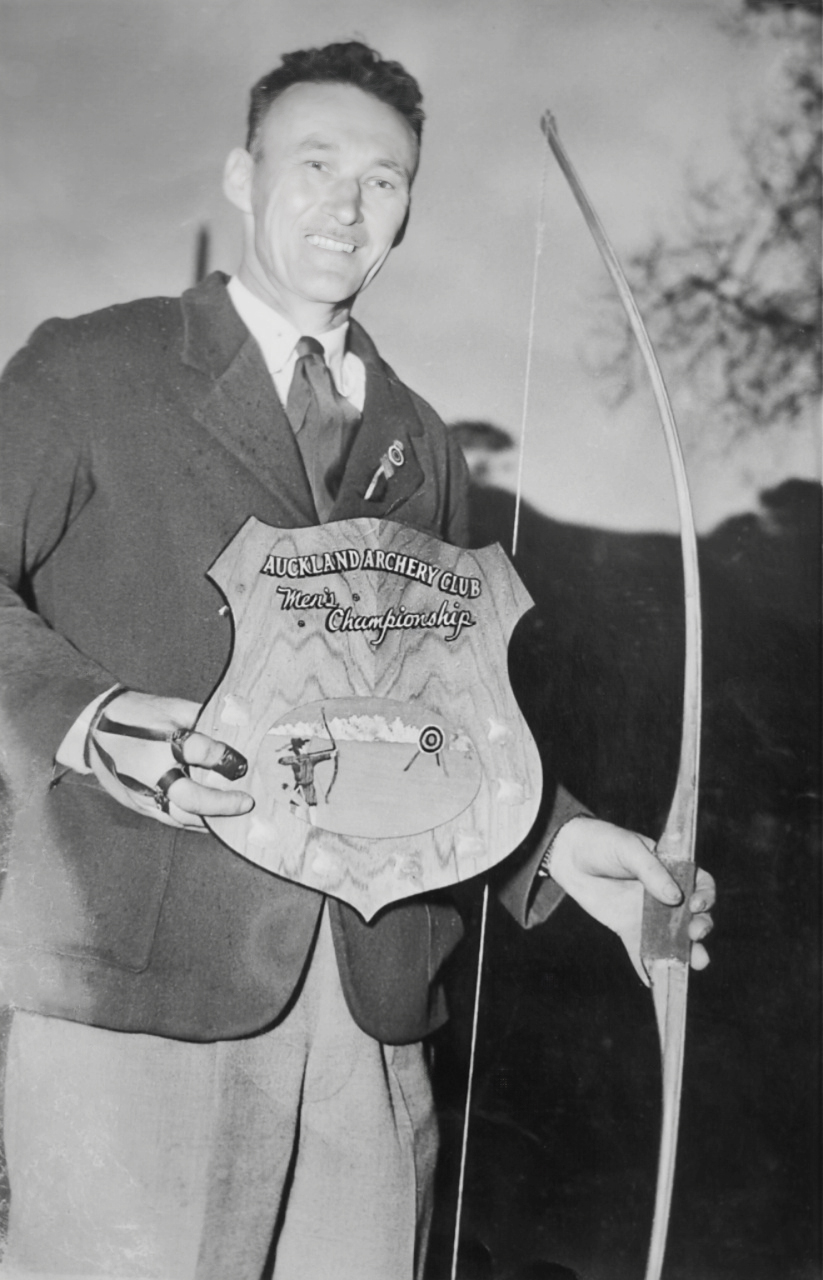
In 1951 Jim had won the National Target Championships, came second in the Field (the first field round he had ever shot in his life), and also, in "the most atrocious flight shooting weather ever experienced", he won the Unlimited Flight class, all with his own gear. If anyone deserved to win the award, it was Jim.
The full criteria for the New Zealand Master Bowman award was decided in 1955. "Master Bowman: the Title of Master Bowman shall be conferred on any affiliated Male Archer, who has won all five NZAA merit pins and who has been placed 1st, 2nd or 3rd three times in the National Field Championships. In addition to the above, the archer must have won the 5 merit pins, and his places in the National Field Championships using only tackle (bows, arrows, strings, and other accessories) or his own manufacture." For ladies, it was the same, except they were not required to make their own gear.
"Impossible!" declared English archer Frank Petty, Vice-President of the Grand National Archery Society in England, when he heard of this. "New Zealand qualifications for the title of Master Bowman will never be met."
Except that in July in 1955, after long discussion (and apparently revoking the previous statement of not awarding it until they had three contenders), the award was conferred upon James William Hinchco. No other archer in New Zealand has ever won this award, apart from Jim's own daughter, Valerie, who won it in 1965.
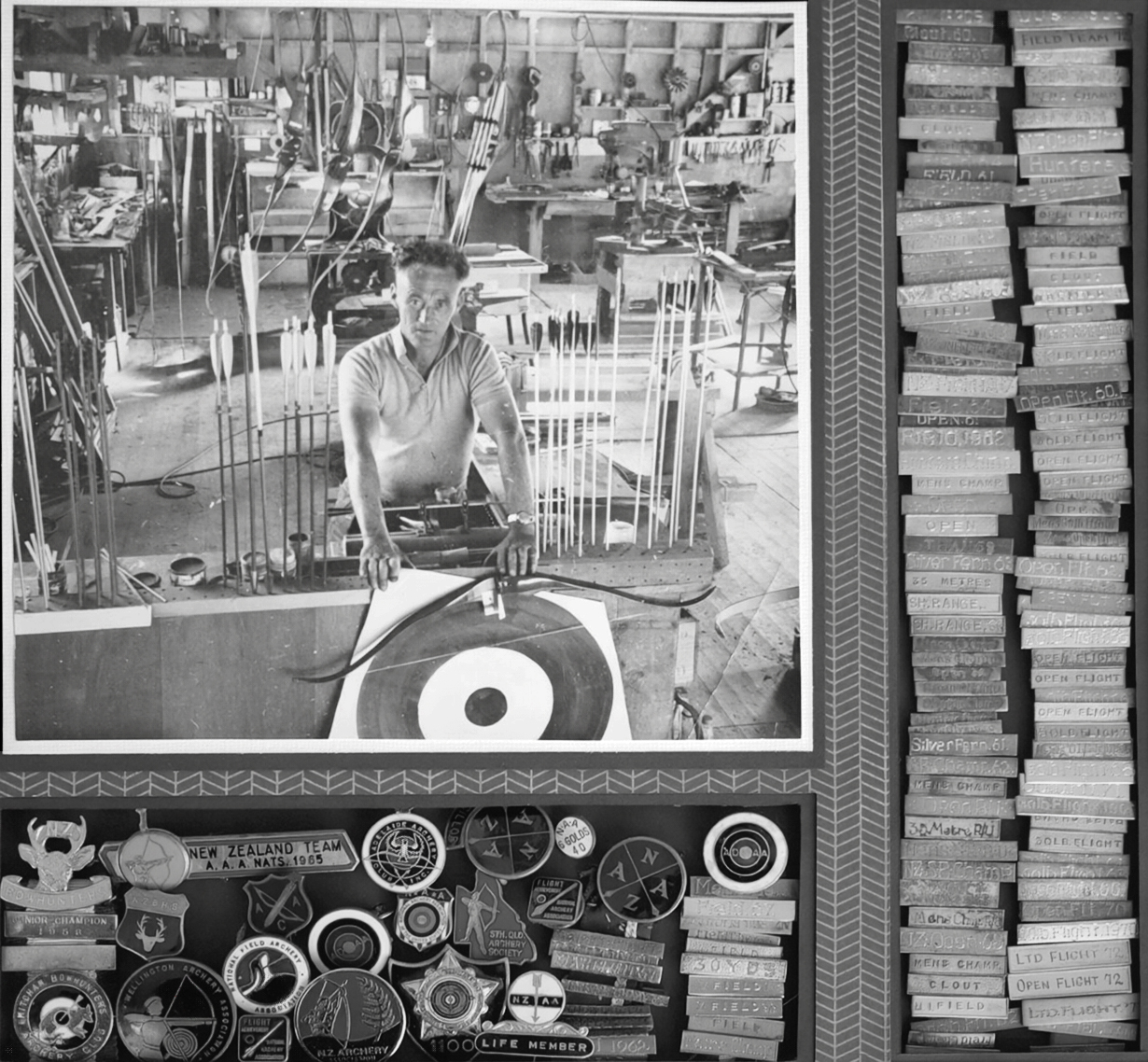
Jim used all his own make of bows, arrows, strings, knocks, piles, and everything else. His daughter Jan remembers that when they were living in Mangere he had a special shed created just for making bows. When the family moved to Albany on the North Shore, Jim had the shed cut in two, and trucked across the bridge so that he could set it up on the property and continue with the business. For a long time, he supplied most of New Zealand with archery equipment, although on personal orders only to maintain his amateur status. Even with this, most of the bows seen at national archery championships and major archery events were his.
It was a superb workshop, an archer's armoury crammed with precision gear. There was an oven to "age-harden" the bows; aluminium tubing for arrows; a wooden mould for setting and shaping; a lathe; intricate vices and drills; various Hinchco-made contraptions for checking arrow straightness; fletcher's gadgets for attaching feathers; and thousands of bits of fibre glass, plastic glass, silver birch, jarrah, mahogany and maple for bows.
Jan remembers that he would spend hours in the shop fiddling with the bows, maybe take an hour to go and shoot in one of the targets that studded their property, and then he was back in the shop, sometimes until 11pm. He was always fiddling with things, trying to make them better, and always striving to improve.
As well as being an eminent bowyer, Jim was an incredibly prolific archer. He attended all National championships in his lifetime, only ever missing one – the inaugural one in 1948 – and he was a member of the NZAA Council. Together with Pat Anglem (who won the ladies' Seefab Cup in 1951), he brought the first Seefab medals to New Zealand. It was a very prestigious international competition, one which Jim Burton of Gisborne, a great friend of Jim Hinchco's, was our greatest archer, winning the Seefab Cup three times (and therefore keeping the trophy) from 1952.
He was New Zealand's first ever Archery Representative, going to the USA to take part in the National Field Archery Association Championships at Sunapee and also in the target championships on the West Coast. In a field of over 300 Field archers, Jim was a very creditable 16th, while in the Flight, he gained two seconds and a third place. He came 24th in the target championships. He was a member of the first "unofficial" team to the Australian Championships in 1962, and a member of the first official team in 1965.
He attended as many meetings as possible in all areas of the sport, although field was his speciality. He was part of the New Zealand Field Archery Association, and the 'Field Section' within the Auckland Archery Club. This 'Field Section', with work from Jim and other archers, became the New Zealand Bowhunters Club in 1951, and then in 1955 it became the Bowhunters Society. He started the Manukau Archery Club in 1957, and the Kauri Park Field Archery Club – which was on his 10-acre property in Albany.
Jim was a very determined man whose life was devoted to archery. His dedication was further shown by his constant generosity to others who were in need, whether it be coaching for juniors or archery clubs that were having trouble starting up. He was always willing to visit schools and fairs to give demonstrations.
Members of his family, too, were bitten by the archery bug. Of his children (Valerie, Jan, Ros and John), only Ros did not shoot. Valerie was a champion field archer in her own right, and a Master Bowman. Jan and John, too, were deep into archery for many years. After Jim's death, Jan and her husband Gerald Jesson continued the archery manufacturing business for a few years until selling it to Trevor Irvine (Arrowhead Archery.) Jim's wife Mabel, on the other hand, was not as interested as her husband, although, Jan remembers, she always provided afternoon tea for after the shoots!
Jim's outstanding achievements in the sport had not gone unnoticed in the wider world. In 1966 Max Smith, an award-winning sports writer for the Auckland Star, published an article on Jim Hinchco in the magazine, and shortly after, the full article in his book Game as you Like, which showcased outstanding New Zealand Sportsmen. Jim appeared on page 143.
However, earlier in the year, he suffered his worst setback in over 20 years of archery. Jim, racing to prepare his own and others' gear for the National Championships in Gisborne, had an accident with a small planing machine. His right hand was caught, and he sliced off the tops of the thumb and the index finger. As he drew back with his right hand, it severely compromised his shooting. Although Jim went to Gisborne he shot only a couple of arrows. It was a difficult time for him, as he was used to shooting with that hand, and the loss of the part of his finger made archery painful. He worked hard, as he always did, at overcoming this setback.
In 1968 Jim went to Australia again as part of the National team – showing how much he had returned to form after the accident. Although his scores were lower than his usual, he attained his 1000 FITA Star with a score of 1013.
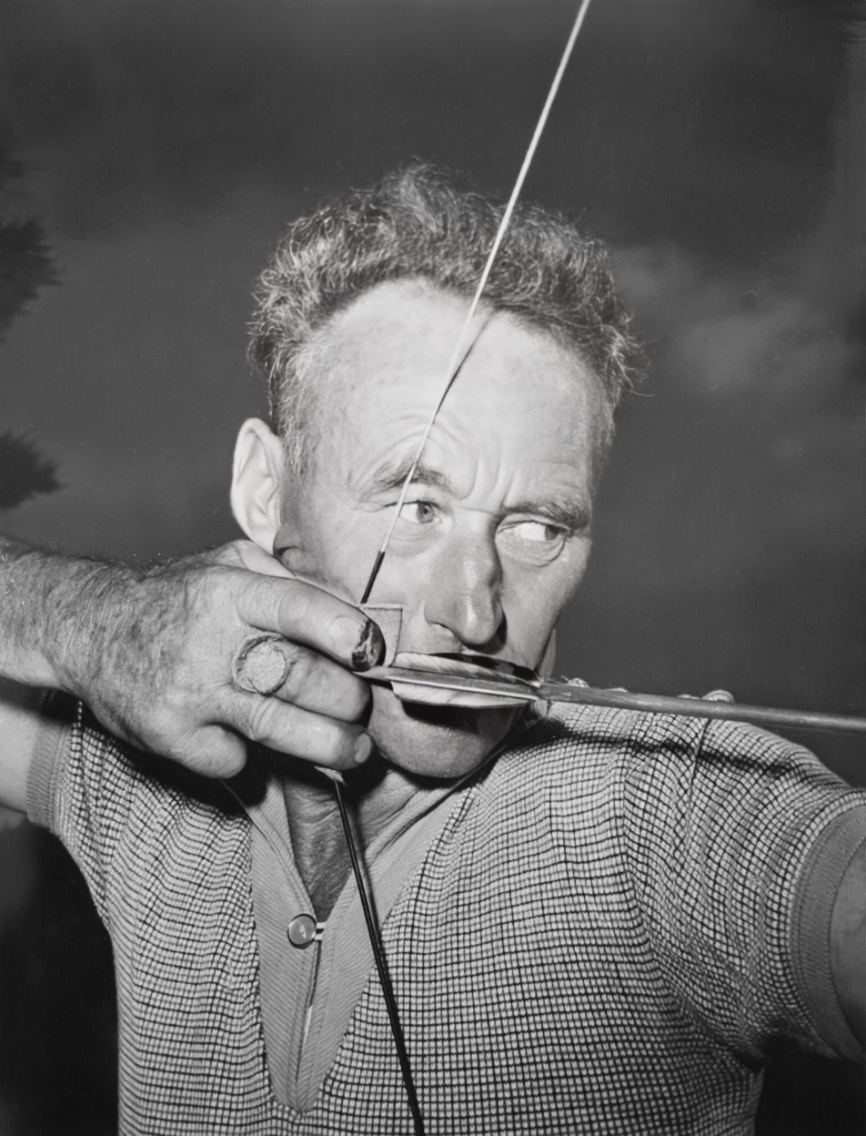
In 1972 Jim was awarded Life Membership to the NZAA. The tribute that was written in the archer is most revealing about his life in archery and his character: "During the 28 years he has devoted to archery he has won virtually every award that archery has to offer. His name is engraved on every trophy in Target, Field, Clout and Flight and he is the only holder of the title of Master Bowman. His service to Archery included not only his many years on the National Council but he has also produced the largest amount of Archery equipment in NZ for his fellow archers. The founder of the Manukau Archery Club, his enthusiasm and devotion to the sport at club and national level has been an inspiration to us all."
Jim always had time to help out fellow archers and clubs when they were in need. Jim Burton remembered later, "Jimmy set me an example of sportsmanship never forgotten. In our heyday we were the top national contenders, and in 1958, while preparing for the Championships, I broke two bows just a few days before the big events. Somehow Jim heard of my dilemma and sent me his special bow with which to beat him!"
When the Massey Archery Club were trying to obtain grounds to house their club, Jim was integral in helping them purchase their land in Red Hills Road. He was asked to open the club by shooting the first arrow (made by his son-in-law, Jerry Jesson), and was awarded honorary membership. They affectionately referred to Jim as "the Fox" because you couldn't ever count him out of a tournament – he might just come back and win just when you weren't expecting.
Not only was he the first ever NZ Representative to America and Australia, Jim also represented New Zealand at the World Championships in Grenoble in 1973, along with fellow archer Charles Hoddinott. The report given in the Archer reveals weather you wouldn't wish on your worst enemy – with rain so severe that the archery grounds were flooded out – and the Swiss Army had to be brought in to help drain it and build wooden pathways for the archers to walk upon when they went to collect their arrows. Charles placed 71st and Jim 87th.
Having been around since the beginning of archery in New Zealand, Jim's contributions were enormous, as well as his stamina. Over the years he designed and built many new bow styles including the ventilated "triumph riser", the first take down recurves and one particularly interesting bow that shot an arrow through a gap in a split riser (true centre flight). Every meet or tournament he shot he used his own equipment, and in 1975 he successfully attained his 1100 FITA Star, shooting a keyhole take-down bow. This may not seem such a large score these days, yet it is a feat all the more remarkable when it becomes known that Jim never used a sight! He always shot barebow using the instinctive method.
On the evening of Saturday September 2nd, 1978, New Zealand lost perhaps its greatest exponent of the sport, for Jim was knocked down by a car when crossing the street in Browns Bay and was killed.
Tributes flowed in for Jim, and there were more people at his funeral than at any Prime Minister's. He was a colossal sportsman and a good friend to many, as well as a great family man. His contribution to the sport of archery in New Zealand was immeasurable and will never be forgotten.
As Jim Burton said in his tribute, "no one person has contributed more to archery – even the great Nick Ryan – your name in New Zealand equates with Doug Easton world-wide."
Highlights of his Achievements include:
- Life member of the NZAA
- Former National Councillor
- First ever NZ Representative
- Member of first (unofficial) NZ team to Australia 1962
- Member of first Official NZ team to Australia in 1965
- Our one and only Master Bowman, along with Valerie his daughter
- Shot in 1973 World Target Championships in Grenoble
- Won 1100 FITA Star in 1975 with self-made bow
- Won a total of 39 National Titles
- Shot at 30 National tournaments
- Started the NZ Bowhunting Society
- Started Manukau Archery Club
- Started Kauri Park Field Archery Club
The Hinchco Memorial shoot is held in memory of Jim Hinchco.
Jim, a master bow maker, engineer and inventor, shaped the development of archery from soon after the war years until his untimely death on 2 September 1978.
His interest in archery started after the war when ammunition was very scarce, he bought a bow from America which quickly broke. So being the innovator he was, he decided he could do better and started to make his own bows. This innovation grew and developed into a full time profession. Over the years he designed and built many new bow styles including the ventilated "triumph riser", the first take down recurves and one particularly interesting bow that shot an arrow through a gap in a split riser (true centre flight).
His bows won many national and international titles. He was known as the "Fox" because his knowledge of arrow flight, curve of the limbs and draw weight allowed him to determine distance simply by watching the shooters form.
Jim assisted the fledgling club with sponsorship and advice but just as important was the inspiration he provided through his status as "The Master" in getting the club started. Unsurprisingly he was asked to open the club at its new site in Red Hills Road with Jim shooting the first arrow, made by his son in law, Jerry Jessen. Jim was awarded the first honorary membership at the club for his support and inspiration.