

Scorecard Guidelines
Welcome to the Massey Archery Club scorecard guide! Whether you're shooting the Marked or Unmarked course, taking a moment to fill in your scorecard correctly makes a real difference — it's what allows us to verify your scores and award you the badges you've worked hard to earn.
Don't worry if it seems like a lot to remember at first. This guide walks you through each part of the card and explains the reason behind it, so it'll soon become second nature. We've put the instructions for each course in separate tabs below, so just select the one that applies to you and you're good to go!
Unmarked Course
Marked Course
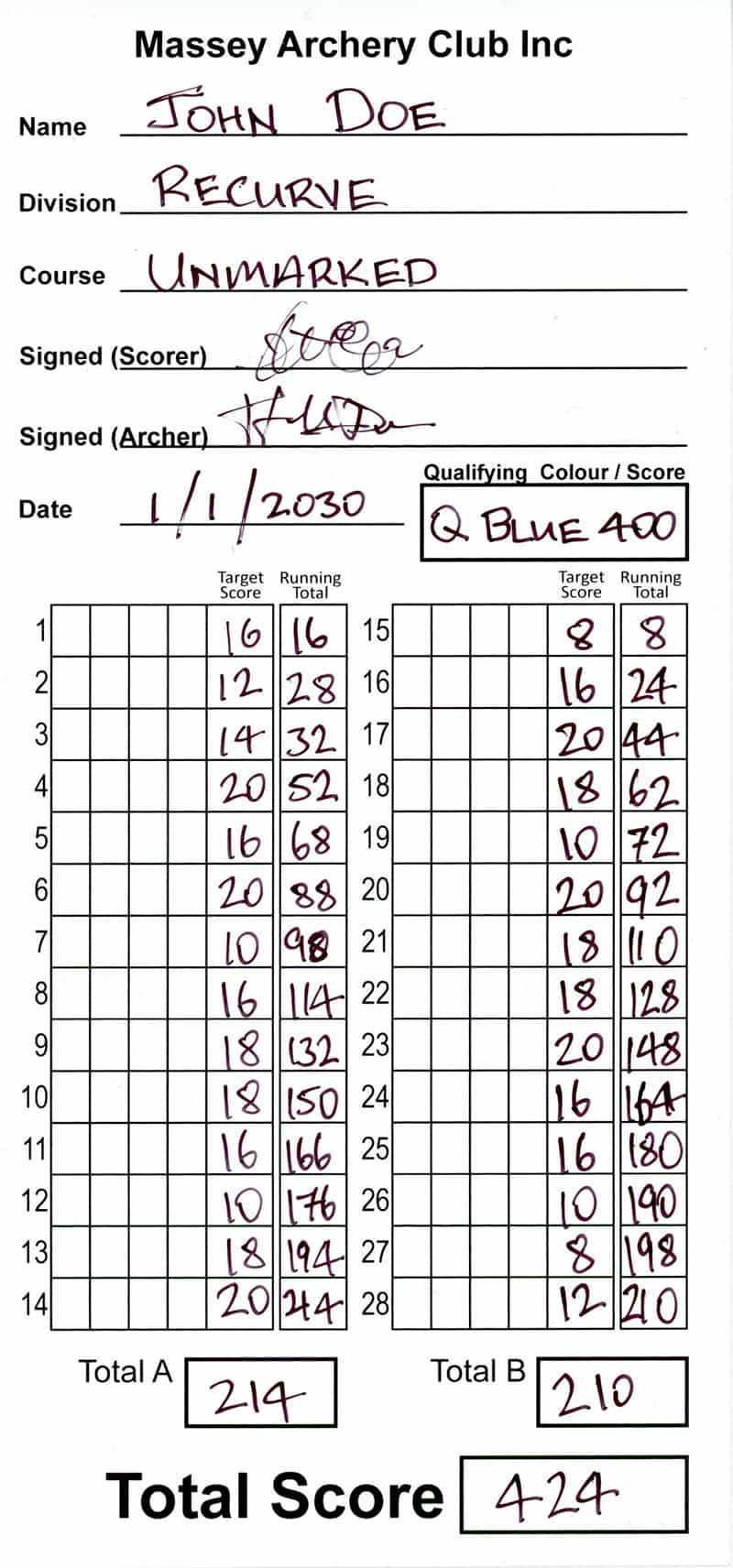
Unmarked Course
Name: Write your First and Last names
Why is this important?
We have a lot of members on our register and there are multiple members who share the same first name; so if you only write your first name, then we won't know who you are if another member has the same first name as you.
Division: For the unmarked course, write down the type of bow that you are shooting with (i.e., Recurve, Longbow, Historical, Compound).
Why is this important?
In order to qualify for a badge, all 3 qualifying scores must be achieved with the same type of bow.
Badges can only be achieved in order (i.e., Blue 400, then Blue 450, 475, 500 and so on). If you have skipped badges and already been awarded a higher badge, you can only go back to earn the earlier badges if you change your bow type to one that you have not already achieved a higher badge with.
Course: Write down which course you are shooting on (Marked or Unmarked).
Why is this important?
Each course has a different set of badges, so we need to know which course's badge you are qualifying for.
Signatures: Both the scorer and archer must sign the scorecard.
Why is this important?
This verifies the authenticity of the achieved score.
Date: Write down the date of the shoot.
Why is this important?
In order to achieve a badge, you must achieve the qualifying score 3 times within a 12 month period. Therefore, a record of the date on the scorecard helps us to track the achievement window.
Qualifying Colour / Score: Write down which coloured peg you are shooting from and which badge score you are aiming to achieve. The list of achievable badges can be found here in the "Unmarked Course" tab.
Why is this important?
If we don't have this information, then your score cannot be attributed towards a badge.
If you only write the peg colour and not the score, then if you were to score 500 from the blue peg (for example), but you have not yet achieved the "Blue 400" badge, then we can't simply assume that you are going for your "Blue 500" badge. Higher scores can be attributed towards lower badges if you choose to collect the badges in order. So a score of 500 from the blue peg could be attributed towards any blue badge from "Blue 400" through to "Blue 500"; so you need to choose which one you are going for.
Total Score: Do the math and write down your total overall score for the whole 28 target round.
Why is this important?
This is the total score that you have achieved for the course and it will determine whether you have achieved the score required for a badge or not.
Even if you're not trying to achieve a badge, you may still like to have it recorded so that you can track your own personal progress over time.
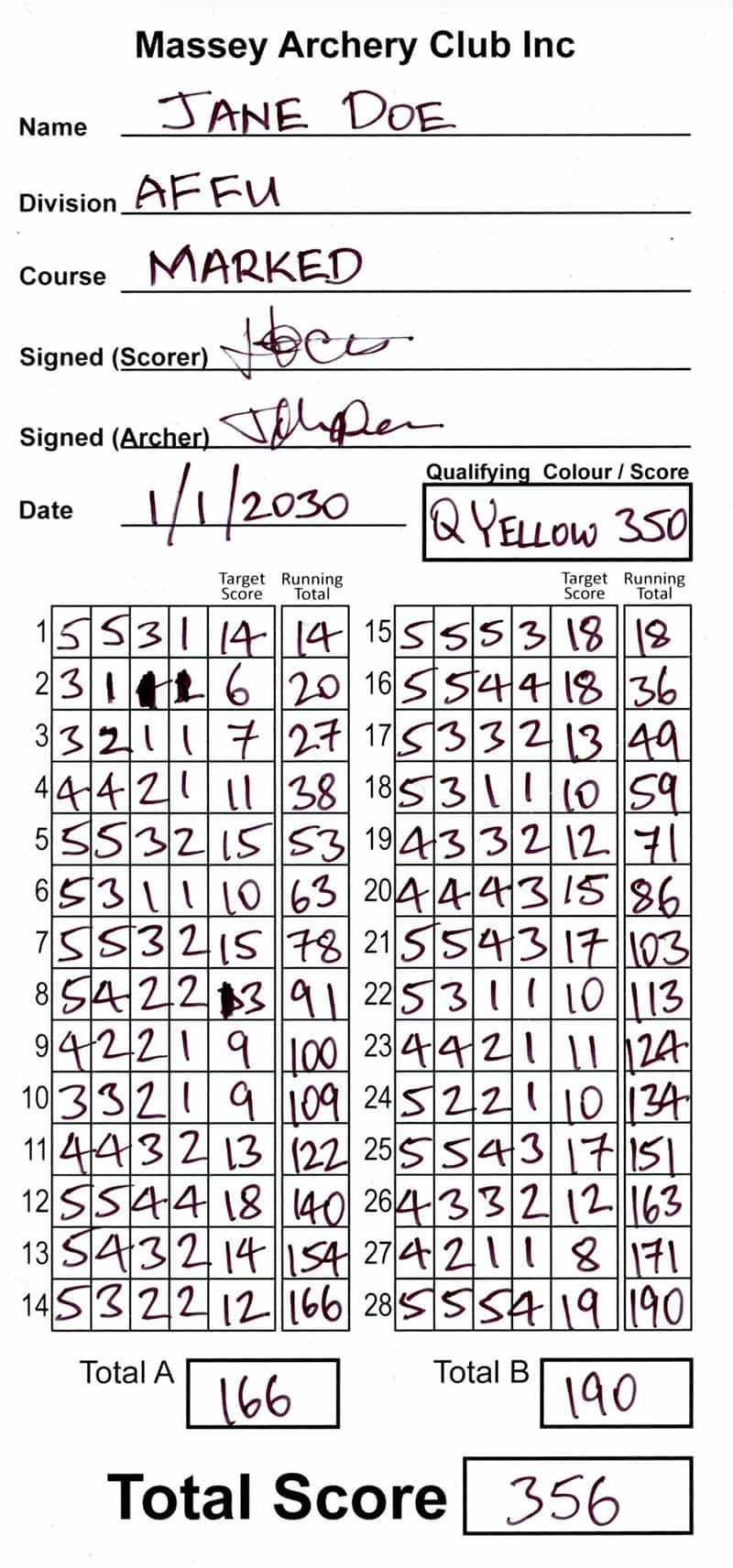
Marked Course
Name: Write your First and Last names
Why is this important?
We have a lot of members on our register and there are multiple members who share the same first name; so if you only write your first name, then we won't know who you are if another member has the same first name as you.
Division: For the marked course, write down your official IFAA division. If you're unsure of your division, refer to the chart on this page.
Why is this important?
In order to qualify for a badge, all 3 qualifying scores must be achieved within the same division.
Badges can only be achieved in order (i.e., Yellow 300, then Yellow 350, 375 and so on). If you have skipped badges and already been awarded a higher badge, you can only go back to earn the earlier badges if you change your shooting division to one that you have not already achieved a higher badge with.
Course: Write down which course you are shooting on (Marked or Unmarked).
Why is this important?
Each course has a different set of badges, so we need to know which course's badge you are qualifying for.
Signatures: Both the scorer and archer must sign the scorecard.
Why is this important?
This verifies the authenticity of the achieved score.
Date: Write down the date of the shoot.
Why is this important?
In order to achieve a badge, you must achieve the qualifying score 3 times within a 12 month period. Therefore, a record of the date on the scorecard helps us to track the achievement window.
Qualifying Colour / Score: Write down the score of the badge you are aiming to achieve. The list of achievable badges can be found here in the "Marked Course" tab.
Why is this important?
If we don't have this information, then your score cannot be attributed towards a badge.
Unlike the Unmarked Course, the badge colours on the Marked Course simply correspond to score ranges - Yellow covers the 300s, Blue the 400s, Green the low 500s, Red the mid 500s, and Black the high 500s - so the colour is determined automatically by the score you're going for. You only need to write the score.
If, for example, you score 500 or more, we can't assume that you are going for the Green 500 badge. Higher scores can be attributed towards lower badges if you choose to collect the badges in order. So a score of 500 could be attributed towards any badge from Yellow 300 through to Green 500, so you need to choose which one you are going for.
Total Score: Do the math and write down your total overall score for the whole 28 target round.
Why is this important?
This is the total score that you have achieved for the course and it will determine whether you have achieved the score required for a badge or not.
Even if you're not trying to achieve a badge, you may still like to have it recorded so that you can track your own personal progress over time.